noise colors
White Noise Machine Volume Under Dream-Self Audio
Set white noise machine volume safely under Dream-Self audio, with dB targets, phone checks, room placement, and a 7-minute nightly routine.
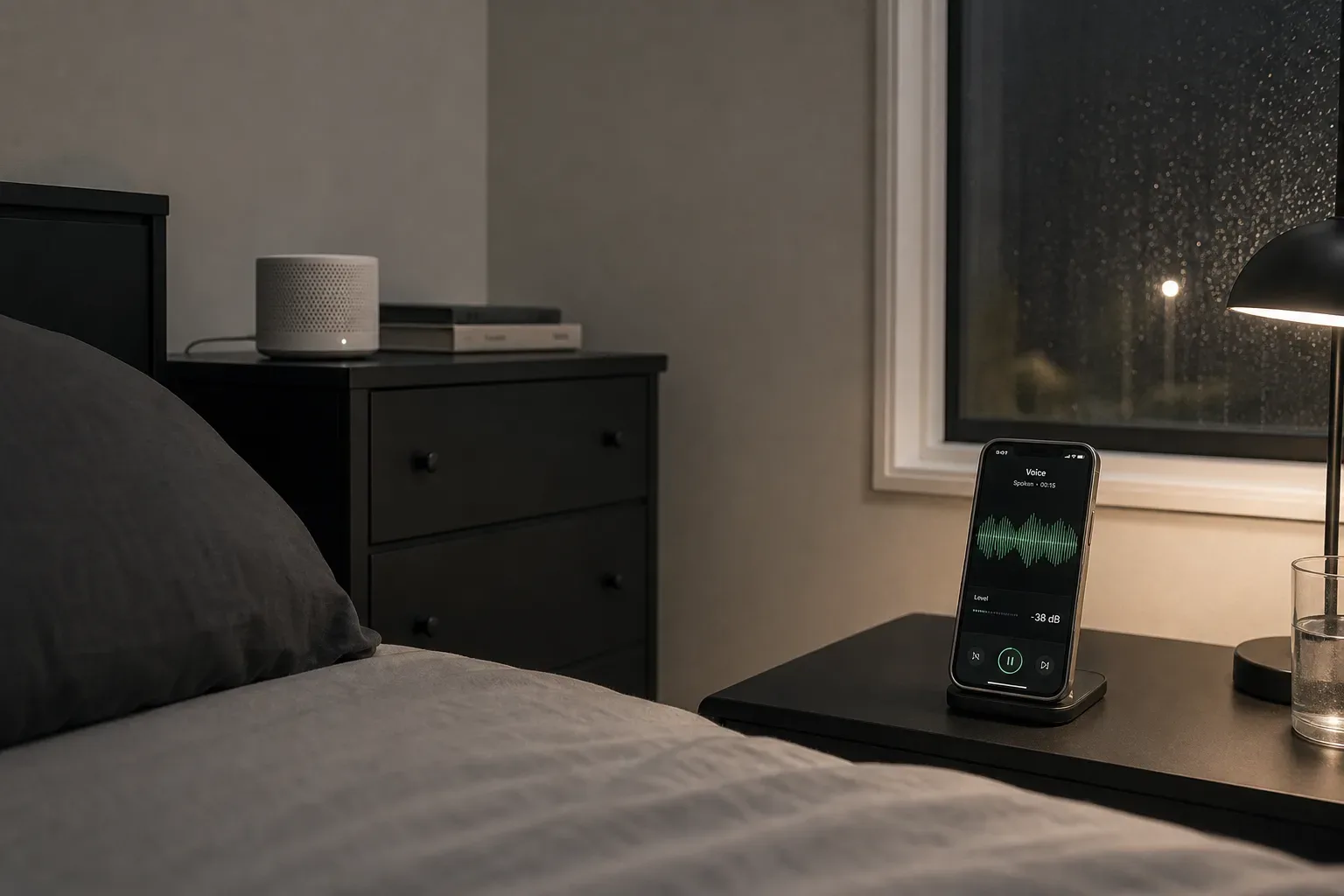
White noise machine volume should sit below Dream-Self audio, not beside it. Set the spoken track first, then raise the noise only until the room softens. For many adults, that means roughly 35 to 45 dBA at the pillow, with the voice still clear at every consonant.
What should white noise machine volume do under Dream-Self audio?
White noise should mask the room while leaving the spoken audio in front.
The useful word is under. White noise is not there to make the Dream-Self track feel large. It is there to cover the small mechanical sounds that keep attention turning outward: traffic seams, a neighbor’s door, the refrigerator relay, a hallway footstep. A white noise signal contains a broad spread of frequencies, so it can cover many small sounds at once. That is its practical virtue and its danger. If it gets too loud, it masks the very voice you meant to hear.
In the AYA Method, the daily audio manifestation practice is the point of contact: each day you listen to a short personalized recording, your Dream-Self Moment, narrated from the version of you who has already manifested the life you intend. Listening is the practice. Repetition is the work. The audio is the method. White noise can prepare the room, but it should not become the method itself.
A simple target works better than a perfect one: set the voice so it is easy to understand at your pillow, then add noise until the room feels less detailed. The U.S. National Institute for Occupational Safety and Health uses 85 dBA over 8 hours as an occupational exposure limit, but sleep audio should be far below workplace limits. A bedroom tool is successful when it lets you lower attention, not when it fills the room.
A quiet noise bed is a floor, not a wall. If the narration has to climb over it, the setting is wrong.
Use the same principle if you prefer pink or brown noise. You can compare the texture in the White noise generator + guide, then return to the same rule: the spoken Dream-Self audio remains primary, and the noise stays secondary.
How do you set the levels in seven minutes?
Set the spoken track first, then bring the noise up from zero in small steps.
This is a short calibration, not a mixing session. You are making one repeatable bedtime setting. If you adjust for 20 minutes, the tool has begun asking for too much attention. The routine below takes about 7 minutes, which is long enough to check intelligibility and short enough to repeat tomorrow.
- Place the machine first. Put the speaker or white noise machine 1 to 2 meters from your pillow if the room allows it. Aim it across the room, not straight into your ear.
- Play the Dream-Self audio alone. Set it to the lowest level where speech is still plain. Listen for soft consonants: s, f, t, and k.
- Add white noise from silence. Raise it one notch at a time. Stop as soon as distant sounds are less noticeable.
- Check the voice again. If you miss a word, reduce noise first. Do not raise both tracks together.
- Mark the setting. Use tape on a physical dial, a saved app preset, or a note that says, for example, phone 40 percent, machine 25 percent.
Speech clarity is the limiter. A 2020 review in Sleep Medicine Reviews noted that environmental noise can fragment sleep, but masking studies vary in size and method. That means your room test matters. The correct setting is not the loudest comfortable setting; it is the quietest setting that reduces interruption.
Here is a plain starting table:
| Room condition | Noise starting point | Dream-Self audio check |
|---|---|---|
| Quiet room, little traffic | 30 to 35 dBA at pillow | Voice should feel close and easy |
| Light apartment noise | 35 to 45 dBA at pillow | Every consonant stays clear |
| Intermittent hallway or street sound | 40 to 50 dBA at pillow | Use only if still restful |
| Infant or child room | Ask pediatric guidance; keep very low | Avoid close placement |
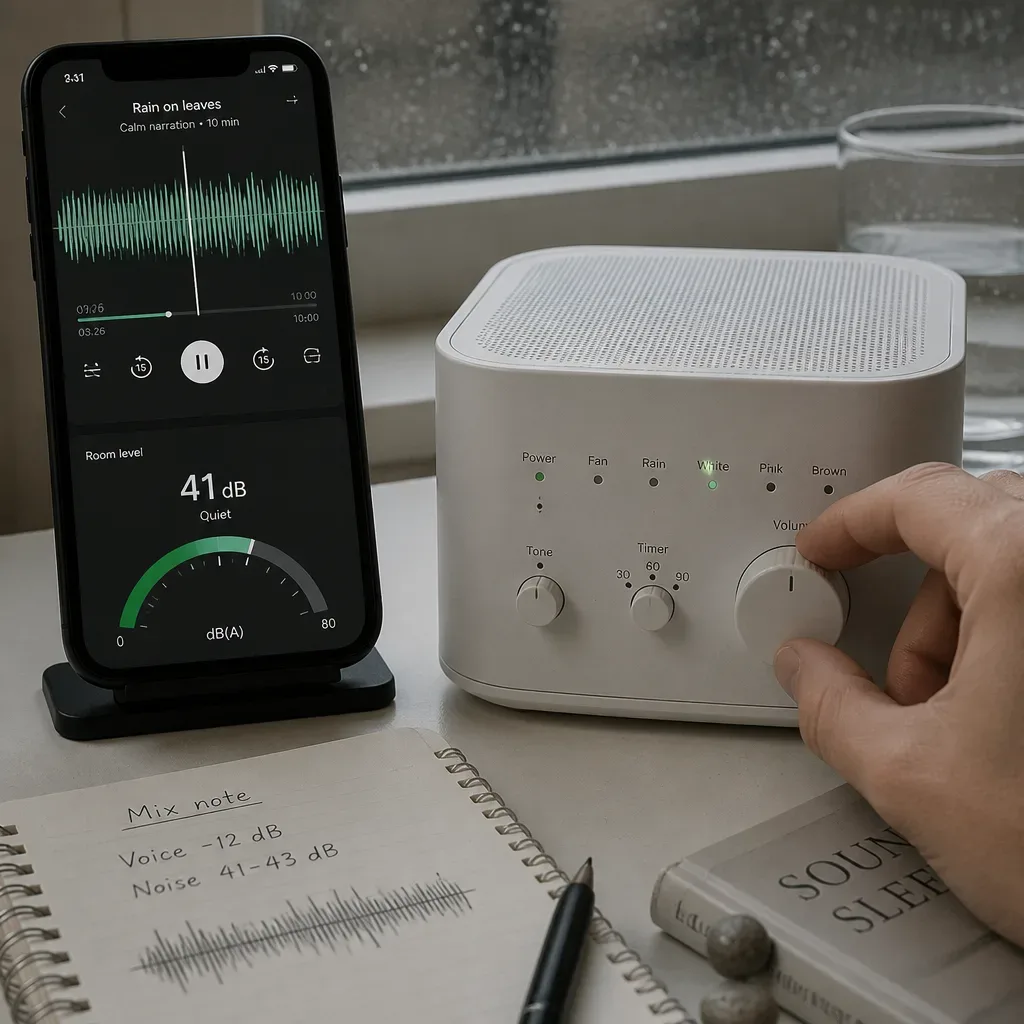
Phone sound-level apps are approximate because most phones are not calibrated meters. Still, a rough reading is better than no reference. If the app says your pillow level is near 60 dBA, lower it unless a clinician has advised otherwise.
How loud is safe for all-night listening?
Use the lowest all-night volume that works, and be stricter for children than adults.
There is no single safe number for every listener, because duration, distance, device quality, room acoustics, and hearing sensitivity all matter. But conservative practice is clear: all-night sound should not be treated like daytime music. The World Health Organization’s 2018 environmental noise guidelines discuss night noise as a health concern, especially when it interrupts sleep. Masking can help some rooms, yet adding sound is still adding sound.
For adults, many practical sleep setups land below normal conversation level. Normal conversation is often estimated around 60 dBA at 1 meter. A white noise bed at the pillow usually should be notably softer than that. If you can hear the noise clearly from the hallway with the door partly closed, it is probably too high for a nightly default.
Children need extra caution. A 2014 study in Pediatrics tested 14 infant sleep machines and found that some could exceed 50 dBA at typical crib distances, with maximum outputs much higher when placed close. The authors advised lower volume, greater distance, and limited duration. That finding is still a useful warning for adults too: small speakers can be louder than they look.
If you have tinnitus, sound sensitivity, untreated sleep apnea, or chronic insomnia, treat sleep audio as support and speak with a qualified professional. A noise machine cannot diagnose breathing pauses, ear symptoms, or persistent sleeplessness. It can only shape the acoustic room.
A safe setting is one you can forget, not one you have to endure.
Where should the machine sit in the room?
Place the noise source between you and the disturbance, but not close to your ear.
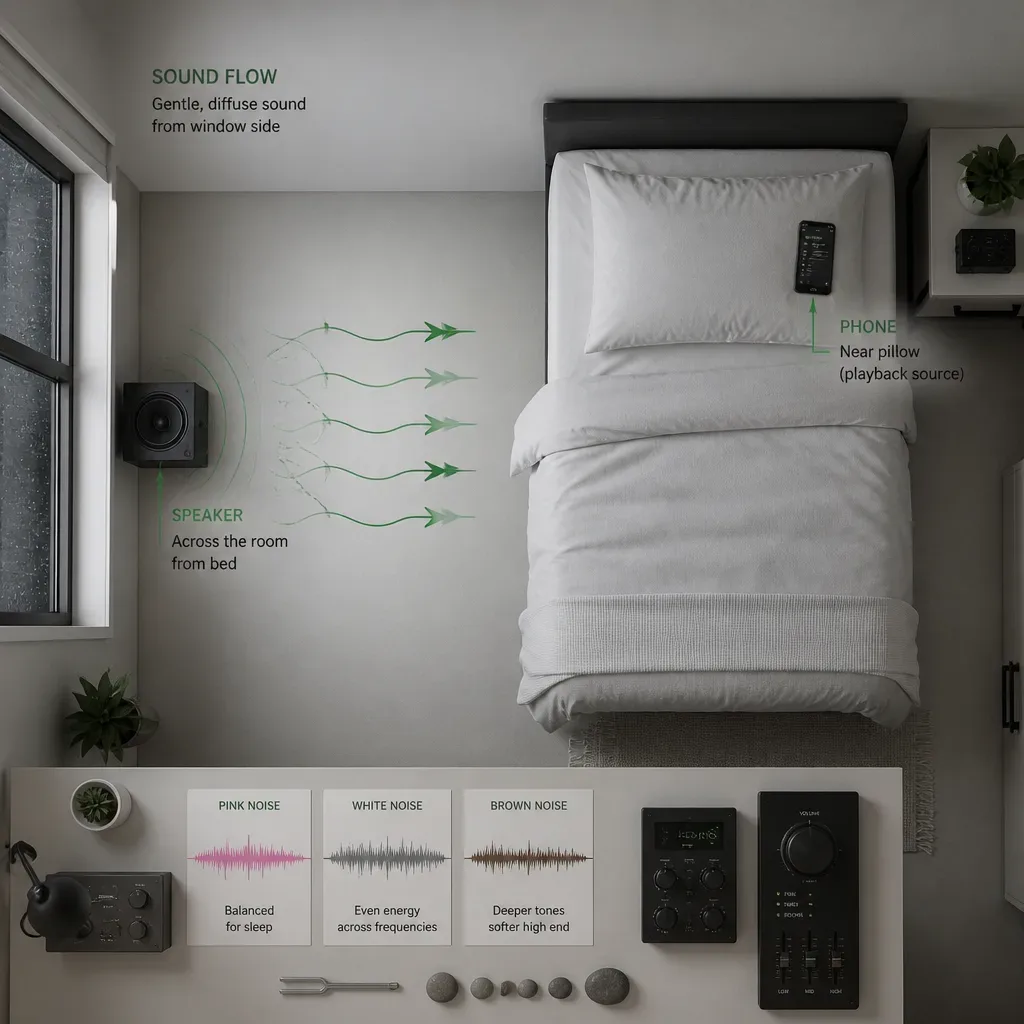
Distance is a volume control. Sound level drops as you move away from a source, and in a real bedroom the walls, bedding, and furniture also change what reaches the ear. If the main disturbance is a window, the noise machine often works better on the window side of the room than on the bedside table. It masks the intrusion before your attention labels it.
Keep the speaker off the pillow, off the headboard, and away from direct ear aim. A meter or two of distance gives the sound time to blend with the room. It also prevents one ear from receiving much more sound than the other. If your Dream-Self audio plays from a phone near the bed and the white noise comes from across the room, the voice will naturally feel closer while the noise stays ambient.
Try these placements before raising volume:
- Near the bedroom door if hallway noise is the problem.
- Near the window side if traffic or wind gaps are the problem.
- Across the room on a dresser if the bedside feels too sharp.
- Low on a shelf rather than under blankets, which can muffle and distort small speakers.
- Away from a crib, pet bed, or anyone who cannot adjust the sound themselves.
In rooms with hard floors and bare walls, white noise can feel brighter because reflections add edge. A rug, curtain, or upholstered chair can reduce that without adding decibels. Acoustic treatment does not need to look like a studio. One thick curtain can change a room more than three extra clicks of volume.
If you use headphones, be more careful. Earbuds put the source close to the eardrum, and phone volume percentages are not reliable safety measurements. For sleep, open-room sound is usually easier to keep low and easy to escape if you wake and want silence.
Which noise color works best under a voice?
Pink or brown noise often sits under speech more gently than bright white noise.
White noise has equal intensity per hertz, which means it can sound hissy to human ears because we perceive high bands strongly. Pink noise reduces level as frequency rises, and brown noise leans still lower. In practice, the lower colors can leave spoken consonants less scratched by hiss, especially when the narration is already soft.
This is not a hierarchy of better sleep. It is a question of fit. The Journal of Theoretical Biology published work in 2012 suggesting pink noise during sleep may support more stable sleep in small samples, and later studies have explored timed acoustic stimulation. The evidence is interesting but not a promise. For your use tonight, the more immediate test is whether the voice remains intelligible.
| Sound type | What you hear | Under spoken audio |
|---|---|---|
| White noise | Bright hiss, broad masking | Good for sharp outside sounds, can blur consonants |
| Pink noise | Softer, balanced wash | Often easier under narration |
| Brown noise | Low hum, less top hiss | Useful if high hiss feels irritating |
| Fan sound | Mechanical, familiar | Can work if it is steady and not rattling |
If you also work with tones, keep them separate from the masking layer. A binaural beat is a perception created when each ear receives a slightly different tone; it usually requires headphones. The claims around focus and sleep are mixed, so use the Binaural beats generator + guide as a listening tool, not a medical treatment. It is usually not the best layer under spoken Dream-Self audio because it asks for stereo precision.
Frequency traditions deserve the same plain handling. Some people like 528 Hz or other Solfeggio tones because the tone feels steady or meaningful. The Solfeggio frequencies guide explains the tradition and the evidence without making medical claims. Under a voice, though, a broad quiet noise bed usually masks real rooms better than a single tone.
What mistakes make the voice harder to hear?
The common mistake is raising the noise to solve every problem instead of reducing the problem at the source.
A noisy bedroom often needs two kinds of work: acoustic and behavioral. Acoustic work is the sound layer. Behavioral work is closing the window latch, moving the charger that whines, turning the fan away from a loose paper, or asking the washing machine not to run at 11:30 p.m. White noise is good at masking small variation. It is poor at fixing a loud, preventable sound.
Watch for these mistakes:
- Setting the white noise first, then trying to force speech above it.
- Placing the noise machine on the bedside table at ear height.
- Using a bright white noise preset when pink or brown would sit lower.
- Letting a phone speaker distort at high volume.
- Changing the level every night, which trains attention to monitor the sound.
- Playing several layers at once: music, tones, noise, and narration.
The brain tends to follow contrast. If the noise surges, loops obviously, clicks at the file boundary, or changes every few minutes, attention returns. Sleepable audio is often disciplined by what it refuses to do. In my own composing, tempo under a resting heartbeat, often below 60 beats per minute, gives the body fewer events to track. White noise should behave with the same restraint.
The quietest usable setting is usually the most repeatable setting. Repeatability matters because bedtime cues gain strength through consistency. Behavioral sleep programs such as cognitive behavioral therapy for insomnia often rely on stable cues and stimulus control, supported by decades of clinical use. A stable sound bed can be one of those cues, as long as it does not become a nightly engineering problem.
When in doubt, remove layers. Play the Dream-Self audio alone for one night. Add noise the next night only if the room needs masking. The comparison will teach you more than a complicated preset.
How do you keep the setting repeatable tomorrow?
Save the physical setup and the numbers so bedtime does not become a sound check.
A repeatable setup has three parts: device position, volume position, and sequence. Put the machine in the same place, start the same audio first, raise the same noise preset second. If you share a room, agree on a ceiling. For example: noise machine no higher than mark 3, phone voice at 45 percent, speaker across the room. The exact numbers are less important than the fact that they stop moving.
Use this compact checklist:
- Before bed: close obvious gaps, chargers, rattles, and windows.
- At bedside: start Dream-Self audio and confirm speech at the pillow.
- Noise layer: add white, pink, or brown noise only until the room softens.
- Meter check: once a week, use a phone app from pillow height for a rough dBA reading.
- Morning note: if you woke from outside sound, adjust placement before volume.
A weekly check is enough for most rooms. You do not need to measure every night. Consumer sound apps can vary by several decibels, but they still reveal large errors. A setting near 40 dBA and a setting near 60 dBA are not subtle differences; one is a soft room bed, the other is approaching conversation level.
If you want a reference track before your nightly audio, press play in the White noise generator + guide and listen for the point where masking begins. Then return to the Dream-Self recording and keep the noise below it. The ear learns relative balance quickly when you change only one control at a time.
The final test is not whether the room sounds impressive. It is whether you stop checking it.
Set the voice where it can be believed quietly, and let the noise stay below the words.