sleep science
Yoga Nidra Sleep: Cue Dream-Self Audio in 10 Minutes
Use this yoga nidra sleep routine to settle the body, protect your ears, and cue Dream-Self audio within a quiet 10-minute window.
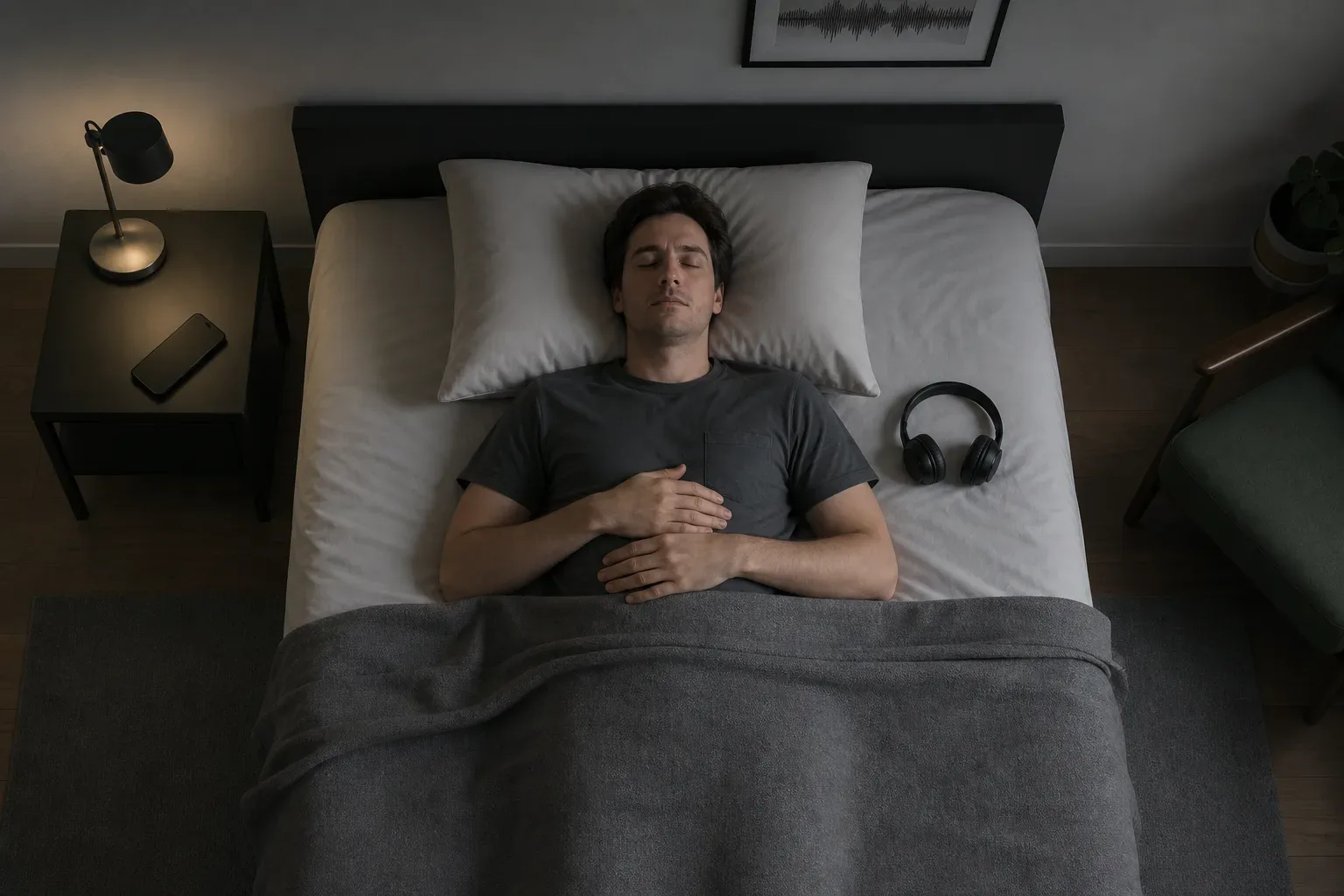
Yoga nidra sleep practice can work as a 10-minute bridge between being wired and being ready to listen. You settle the body first, then cue Dream-Self audio once attention is soft. The sequence is simple: prepare sound, scan the body, breathe low, listen, and let sleep approach without pressure.
What does yoga nidra sleep do in 10 minutes?
Yoga nidra sleep practice gives the nervous system a clear rest sequence before bed.
In classical yoga nidra, you lie down and follow spoken cues through the body, breath, and awareness. For sleep, the mechanism is plain: fewer choices, less movement, steadier attention. The American Academy of Sleep Medicine and Sleep Research Society recommend at least 7 hours of sleep for most adults, but the hour before bed often decides whether those 7 hours are easy or fragmented.
A short practice will not replace treatment for chronic insomnia. Cognitive behavioral therapy for insomnia, or CBT-I, remains the better-studied first-line care, with multiple clinical guidelines behind it. Yoga nidra sits in a different lane: it reduces arousal, gives the mind a track, and lowers the need to solve anything while horizontal.
The evidence is promising but still modest. Small yoga nidra studies have reported improvements in perceived sleep quality, stress, and relaxation markers, often with samples under 100 people. Broader mindfulness research is larger; a 2014 JAMA Internal Medicine review found mindfulness programs had moderate evidence for anxiety and stress reduction, which matters because pre-sleep arousal is one common sleep barrier.
The useful test is not whether you feel mystical. The useful test is whether your jaw softens, your breathing slows, and you stop negotiating with the pillow. A sleep ritual is successful when it removes decisions from the edge of the bed.
How should you set the room and audio before lying down?
Set the room so the body has fewer signals to monitor.
Start with sound. If your room has traffic, neighbors, or a loud refrigerator, a low masking layer can help. Press play on the White noise generator + guide and listen for the difference between noise that covers sharp changes and noise that becomes another thing to tolerate. White noise contains equal acoustic power per hertz; many people prefer pink or brown noise at night because the high end is less bright.
Keep volume conservative. The World Health Organization’s night noise guidance has used 40 dB outside as a protective target for community noise, and bedrooms are usually more comfortable below ordinary conversation level, which is about 60 dB. For sleep audio, I suggest starting low enough that you can hear your own breathing clearly. If earbuds make the signal feel too close, use a small speaker across the room.
Light matters too. Bright evening light can delay melatonin timing; laboratory work from researchers such as Charles Czeisler has shown that light exposure can shift circadian rhythms by measurable hours. You do not need a perfect cave. You need a repeatable cue: dim lamp, screen down, one track ready.
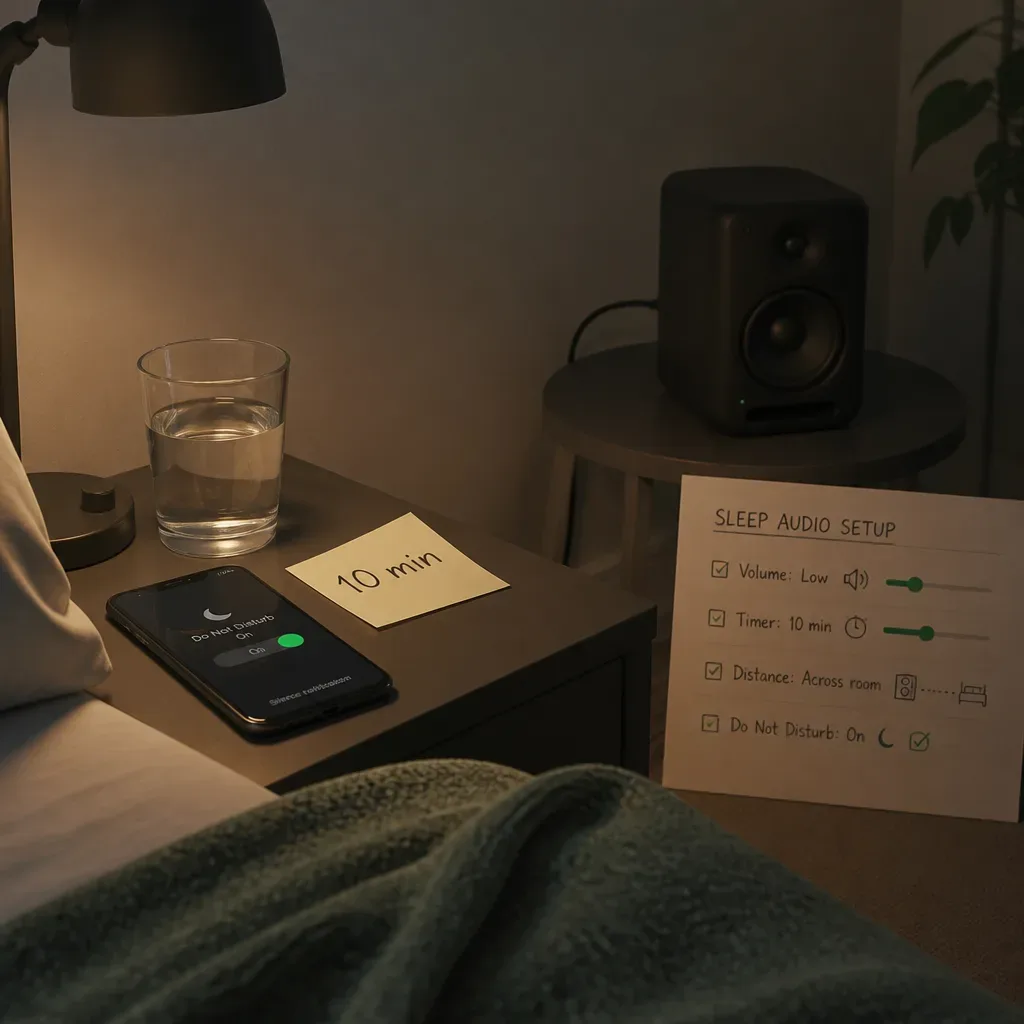
Use this quick setup before the 10-minute practice:
- Put your phone on Do Not Disturb.
- Choose one sound bed or no sound bed, not three.
- Set a sleep timer for 15 to 25 minutes if you use headphones.
- Place a blanket over the lower ribs if you tend to feel exposed.
- Keep the volume below the level of easy speech.
The best sleep sound is not the prettiest sound; it is the one your body stops checking.
What is the exact 10-minute yoga nidra sleep sequence?
Use a timed sequence that moves from environment, to body, to breath, to audio.
The point is not to perform yoga nidra perfectly. The point is to become still enough that listening can do its work. In my classes since 2016, most restless students do better with a short map than an open-ended invitation. Ten minutes gives the mind a container. The body likes containers.
| Minute | Cue | What to do |
|---|---|---|
| 0:00-1:00 | Settle | Lie on your back or side, jaw loose, hands supported. |
| 1:00-3:00 | Contact | Feel heels, calves, pelvis, ribs, shoulders, skull. |
| 3:00-5:00 | Rotation | Move attention from right hand to right arm, left hand to left arm, face, torso, legs. |
| 5:00-6:30 | Breath | Count 6 slow exhales, without deepening the inhale. |
| 6:30-7:00 | Pause | Notice the whole body at once. |
| 7:00-10:00 | Dream-Self audio | Press play or let it begin from a queued track. |
Here is the same practice as a numbered guide:
- Lie down before you feel desperate for sleep.
- Let the back of the body become heavy, even if the mind stays alert.
- Move attention through body parts at a steady pace, about 2 to 4 seconds per point.
- Count only the exhale, from 6 down to 1, then stop counting.
- Begin the Dream-Self audio when the body is quiet enough to receive a voice.
The exhale count is intentionally short. Slow breathing around 6 breaths per minute has been studied for heart-rate variability and relaxation, but forcing breath can wake people up. For sleep, a gentle exhale emphasis is usually enough. Do less than you could; sleep responds better to permission than effort.
If you lose your place, that is not failure. Yoga nidra often includes drifting in and out. In EEG research, relaxed wakefulness is commonly associated with more alpha activity, and drowsiness with theta; yoga nidra studies have observed shifts in these bands, though samples are small and methods vary. You are not chasing a brainwave. You are giving awareness a quieter job.
When should Dream-Self audio begin?
Begin Dream-Self audio after the body scan, around minute 7, when the body is settled but attention has not fully dropped away.
This is where the AYA Method fits naturally. The AYA Method is a daily audio manifestation practice. Each day you listen to a short personalized recording, your Dream-Self Moment, narrated from the version of you who has already manifested the life you intend. Listening is the practice. Repetition is the work. The audio is the method.
In this routine, yoga nidra is not competing with that audio. It prepares the room inside the body. A tense body listens defensively. A settled body listens with less friction. That distinction matters because the daily affirmation and Manifestation Board can support the practice, but they are not the core here. The listening is the core.
There is no strong clinical trial proving that personalized future-self audio changes sleep architecture. Say that plainly. What we do have is a practical overlap: repeated audio cues can become conditioned signals. In behavioral sleep medicine, stimulus control asks the bed to become associated with sleep rather than wakeful problem-solving. Your recording can become part of that consistent cue, as long as it stays calm and brief.
Keep the Dream-Self Moment short at night. Three to 7 minutes is enough for most bedsides. If the track is longer, use a sleep timer. If the content becomes too activating, move it earlier in the evening and keep yoga nidra as the final practice. The right audio at night should not ask you to become more alert in order to improve your life.
What if your mind stays awake while the body rests?
If the mind stays awake, keep the body resting and reduce the number of inputs.
Many people treat a busy mind as proof that the practice failed. It is usually proof that the practice revealed what was already running. In sleep clinics, insomnia is often described through conditioned arousal: the bed becomes a place where the brain expects effort. A 2021 review in Sleep Medicine Clinics discussed hyperarousal as a central feature in many insomnia models, spanning cognitive, emotional, and physiological arousal.
Use fewer tools, not more. If you add breathwork, a frequency track, a voice, a visualization, and a timer, the mind may start supervising the whole arrangement. Choose one anchor under the voice. If you prefer a steady tone, read the Solfeggio frequencies guide with the evidence line intact: the tradition is meaningful to many listeners, but sleep claims are not clinically settled.
Binaural beats are similar: interesting mechanism, mixed evidence. A binaural beat is created when each ear receives a slightly different tone, and the brain perceives a third rhythmic difference. The Binaural beats generator + guide is useful for hearing that effect directly. Research reviews have found variable results depending on frequency, session length, and study design, so treat it as a listening aid rather than a guarantee.
When the mind stays awake, try this adjustment for 3 nights before changing the whole routine:
- Shorten the body scan by 2 minutes.
- Lower volume by one step.
- Use side-lying if the back feels too exposed.
- Remove lyrics or changing music.
- Stop checking whether sleep has arrived.
If you have loud snoring, witnessed breathing pauses, severe daytime sleepiness, panic at night, or chronic insomnia lasting more than 3 months, speak with a qualified clinician. Audio can support rest, but it should not hide a medical signal.
Which sounds pair best with yoga nidra for sleep?
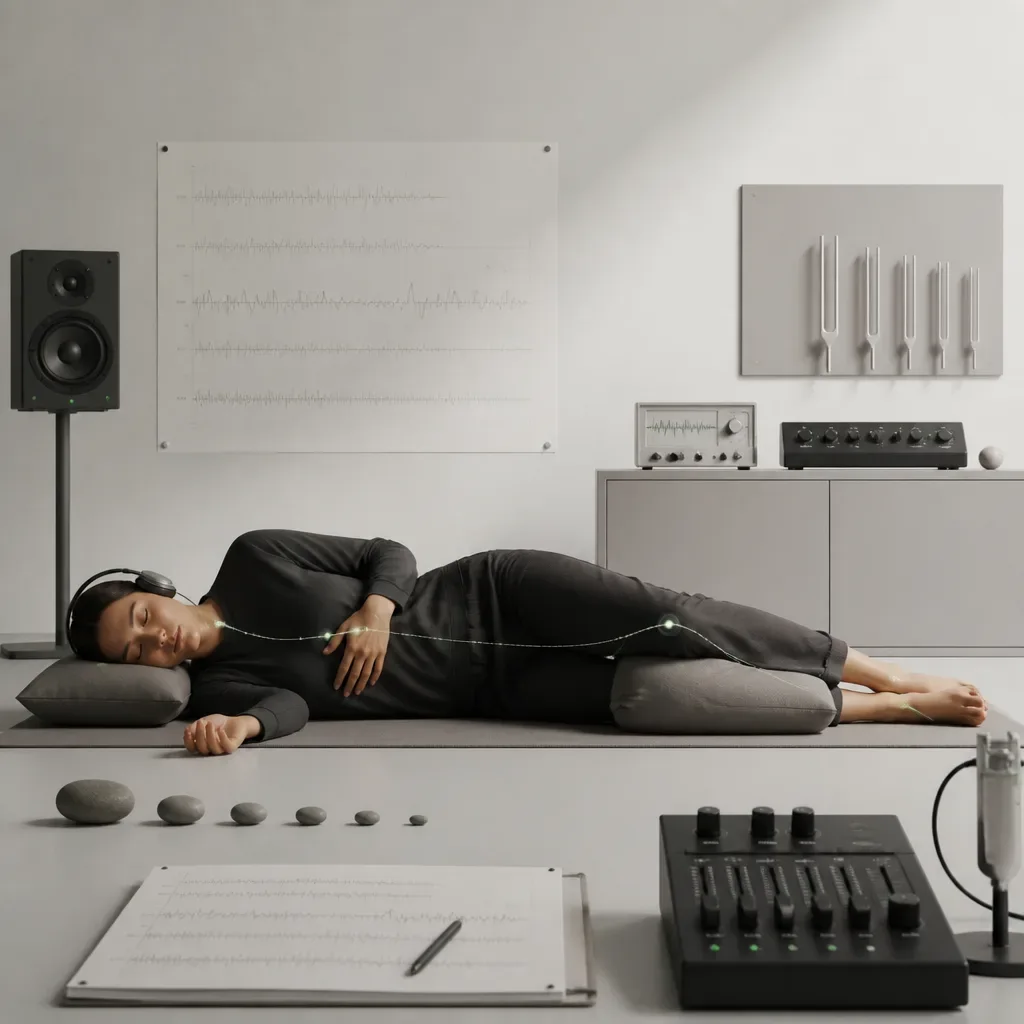
The best pairing is a stable, low-volume sound that does not compete with the guide.
For many bedsides, that means brown noise, pink noise, a low drone, or silence. Brown noise is not deeper sleep. It is deeper sound: more low-frequency content, less high-frequency hiss. Some nervous systems prefer it because sudden changes are masked without adding sparkle. Yours gets a vote.
Here is a plain comparison:
| Sound | Good for | Caution |
|---|---|---|
| Silence | Quiet rooms, sensitive ears | Small sounds may feel sharper. |
| White noise | Masking traffic or voices | Can feel hissy if too loud. |
| Pink noise | Softer masking, balanced tone | Still keep volume low. |
| Brown noise | Low hum, less high-end edge | Bass can travel through walls. |
| Binaural beats | Headphone-based focus on a beat | Evidence is mixed; avoid loud earbuds. |
| Solfeggio tone | Ritual, single-frequency anchor | Tradition is not the same as sleep proof. |
There is some research on pink noise and sleep-dependent memory, including small laboratory studies in older adults where timed acoustic stimulation enhanced slow-wave activity. Those studies used precise timing and equipment, not a random phone speaker all night. Still, they suggest that sound can interact with sleep physiology when applied carefully.
For this yoga nidra sleep routine, do not chase precision past usefulness. A 174 Hz, 432 Hz, or 528 Hz tone may feel pleasant to you; that matters for adherence. But the stable cue, low volume, and repeated timing are probably doing more bedtime work than the number itself. If you want to compare tones, use the Solfeggio frequencies guide in the afternoon, then choose one for the week.
If masking is the problem, use the White noise generator + guide. If a gentle beat helps you keep attention steady, test the Binaural beats generator + guide before bedtime, not for the first time at midnight. Night is for known tools.
How do you repeat the routine without making it another task?
Repeat the routine by keeping it short, measurable, and forgiving.
A sleep ritual fails when it becomes a performance review. Track only 2 things for 7 nights: whether you started the practice, and whether you kept the volume low. Do not grade the depth of rest. Do not measure spiritual quality. If you use a wearable, remember that consumer sleep staging is estimated, not direct polysomnography; even good devices can misclassify quiet wake as sleep.
The National Sleep Foundation’s widely cited sleep duration recommendations place most adults at 7 to 9 hours, but timing and consistency also matter. Try the practice at roughly the same point in your evening for one week. A consistent cue helps the brain predict what comes next. Predictability is not boring to the nervous system; it is safe information.
Use this 7-night test:
- Nights 1 and 2: yoga nidra only, no Dream-Self audio, to learn the body scan.
- Nights 3 and 4: add Dream-Self audio at minute 7.
- Night 5: adjust position, not content.
- Night 6: adjust volume lower if you remember the track too vividly.
- Night 7: keep what felt easiest, remove one extra tool.
After a week, ask three plain questions. Did I resist bedtime less? Did my body settle faster? Did the audio feel like a cue rather than a demand? If two answers are yes, keep the routine for a month. Practice changes through repetition, not novelty.
A gentle routine kept for 30 nights teaches more than a perfect track used once.
Lie down, press play, and let the room get plain.